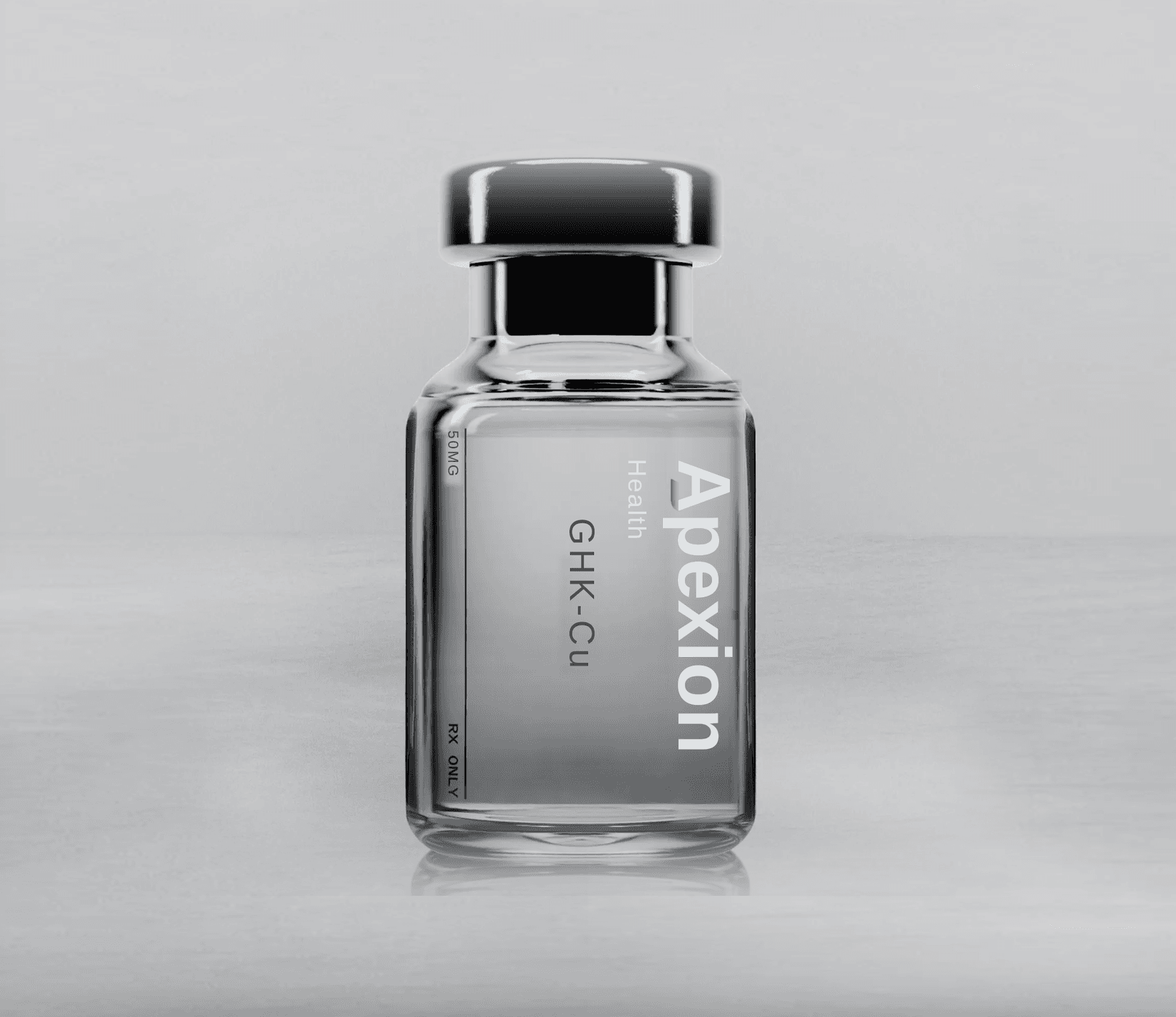
Apexion Health GHK-Cu treatment vial
AESTHETICSCOPPER PEPTIDE

MONTHLY SUPPLY · 2MG/DAY

GHK-CU

TREATMENT

Copper peptide for collagen synthesis and skin renewal

SUPPORT

GHK-Cu is a naturally occurring tripeptide-copper complex found in human plasma. It signals fibroblasts to produce collagen and elastin, and modulates matrix metalloproteinases for balanced skin renewal.

Shop Now

Lab-Tested · Physician-Supervised · Discreet Delivery

Apexion Health — AESTHETICS

YOUR SKIN'S NATURAL REPAIR SIGNAL, AMPLIFIED.

GHK-Cu — glycyl-L-histidyl-L-lysine copper complex — is a peptide your body produces naturally, with highest concentrations during wound healing and tissue remodeling. Levels decline significantly with age. GHK-Cu signals fibroblasts to increase collagen and elastin synthesis, modulates matrix metalloproteinases to balance breakdown and renewal, and exerts antioxidant and anti-inflammatory effects at the cellular level.

Clinical Benefits

GHK-CU SUPPORTS YOUR HEALTH AT THE CELLULAR LEVEL

  1. 01.

    STIMULATES FIBROBLAST COLLAGEN AND ELASTIN SYNTHESIS

  2. 02.

    MODULATES MATRIX METALLOPROTEINASES FOR BALANCED SKIN RENEWAL

  3. 03.

    SUPPORTS REDUCTION IN FINE LINES AND SKIN LAXITY

  4. 04.

    PROMOTES WOUND HEALING AND TISSUE REPAIR

  5. 05.

    SUPPORTS HAIR FOLLICLE REGENERATION AND THICKNESS

  6. 06.

    SYSTEMIC ANTI-INFLAMMATORY AND ANTIOXIDANT PROPERTIES

Shop Now

Clinical Evidence

How It Works in the Body

01 — Dose & Efficacy

Tissue Remodeling Activity

Collagen Synthesis Stimulated at 10⁻⁹–10⁻¹² M70%
Angiogenesis Enhanced vessel formation55%
Antioxidant Activity Elevates cellular GSH & SOD45%

Gul et al., Wound Repair Regen 2008; Pickart et al., J Biomater Sci 2015

02 — Hormone Panel

Tissue Remodeling Biomarkers

MarkerWithoutWith Treatment
Wound Contraction (D13)%
28.2
64.5+36.3
TNF-α (wound)Rel.
High
↓ Significant↓ (est.)
MMP-2 ActivityRel.
Elevated
Suppressed↓ (est.)
Collagen Synthesis% abv
0
+30–70%+30–70%

Strong preclinical — limited human RCT data

GHK-Cu has extensive in vitro/animal evidence. Human data limited to small cosmetic studies (anti-aging, <50 subjects). No large RCTs for systemic use. Peptide declines ~60% by age 60.

Pickart et al., J Biomater Sci 2015; Siméon et al., J Invest Dermatol 2000

03 — Protocol

Tissue Remodeling Framework

BaselinePre-treatment
  • Skin/tissue photo assessment
  • QOL & appearance scores
  • Collagen/elastin markers
RemodelingWeeks 1–8
  • Topical or injectable per protocol
  • Tissue assessment q2 weeks
  • Tolerability & side effects
MaintenanceMonths 3+
  • Per protocol continuation
  • Tissue quality q1–3 months
  • Long-term tracking

Mechanism-based approach — limited human evidence

Most evidence from in vitro, animal, and small cosmetic studies. Topical 1–3% formulations studied for photoaging. Injectable protocols lack robust RCT data. No serious safety signals.

All protocols physician-supervised and adjusted per individual labs.